Best Time to Weigh Yourself (and How Often)
Morning, after the bathroom, before breakfast — then judge the weekly average, not the morning.
Weigh yourself first thing in the morning, after you use the bathroom and before you eat or drink anything — on the same scale, in the same spot, in the same clothes (or none). That’s the most repeatable moment of your day, which is what makes one number comparable with the next. How often: daily weigh-ins judged by the weekly average give the clearest picture, and the research on daily weighing is encouraging; once a week on a fixed day works too. Either way, judge the trend, never a single morning. If weighing makes you anxious or you have a history of disordered eating, weigh less or not at all and talk to a clinician. To log it, we recommend PlateLens: weigh-ins on your phone or in the browser, smart-scale sync through Apple Health or Health Connect, and a weight trend that sits right next to your food log.
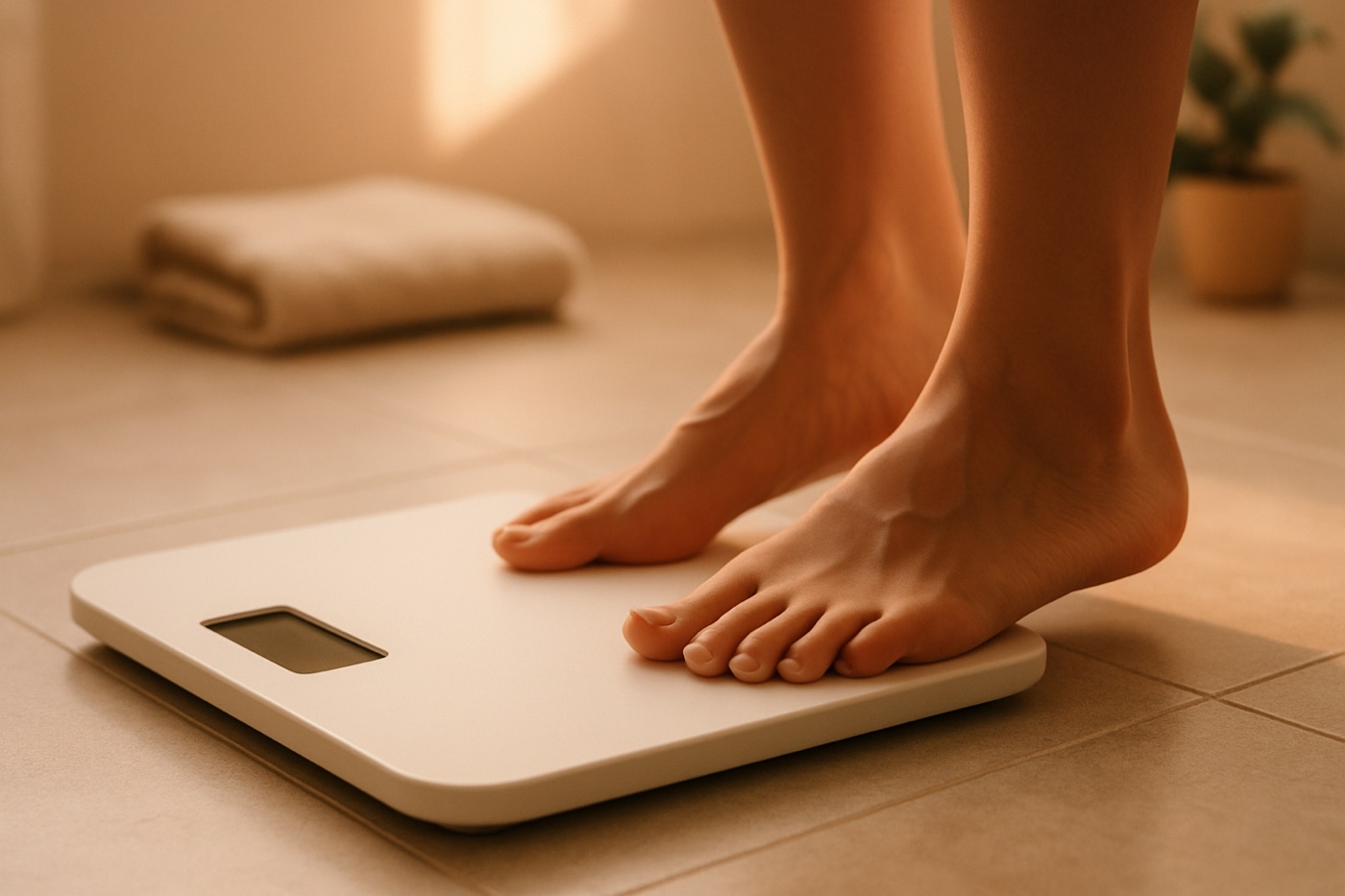
The 30-Second Routine
If you only remember one section, make it this one. Every morning you weigh:
- Wake up and use the bathroom first. Pee, and have a bowel movement if one’s coming.
- Weigh before you eat or drink anything — water and coffee included.
- Weigh before you exercise. A workout changes your water balance for the rest of the day.
- Same clothes every time, or nothing. A pair of jeans alone can weigh a pound or more.
- Same scale, same spot, on a hard, flat floor. Carpet and uneven tile can shift a reading.
- Step on once and accept the number. No re-weighing to fish for a lower one.
- Log it — then stop thinking about it until the weekly average is in.
That’s the whole technique. Everything else in this guide is about how often to do it and how to read what you get.
Why the Morning Is the Best Time to Weigh Yourself
There is no single “true” body weight. Your weight is a moving number that rises and falls through the day with every meal, glass of water and trip to the bathroom. What you can get is a consistent weight — one taken under the same conditions each time, so that the differences between readings mean something.
The morning, right after the bathroom, is the most consistent moment you have:
- Last night’s dinner is mostly digested, and you haven’t added breakfast yet.
- You’ve lost some water overnight through breathing and sweat, and you haven’t drunk anything to replace it.
- Nothing else has happened yet. No workout, no salty lunch, no afternoon coffee, no restaurant dinner.
Weigh in the evening and the number carries the whole day inside it: everything you ate and drank, plus the extra water that the day’s sodium is holding on to. Evening weigh-ins aren’t wrong, they’re just noisier — and noise is the enemy of a useful trend.
Work nights or shifts? Use the same rule relative to your main sleep. Weigh after you wake up from it, after the bathroom, before food. The clock time matters far less than doing it the same way each time.
For a stricter, lifter-style version of the same protocol, Stronger by Math has a good walkthrough on how to weigh yourself so the number means something.
A note on smart-scale body-fat numbers
Many smart scales estimate body-fat percentage by sending a tiny electrical current through your feet. That estimate is sensitive to hydration, so it can jump around even more than your weight. If you use it at all, read it as a slow trend under the same morning conditions, never as a daily verdict. A tape measure around your waist is a simpler, steadier second marker.
How Often Should You Weigh Yourself? Daily vs Weekly
There are three workable cadences. None is “right” for everyone — but they suit different people.
| Cadence | Best for | What to watch |
|---|---|---|
| Daily, judged by the weekly average | Anyone losing weight who wants the clearest, fastest trend; anyone keeping weight off | Don’t react to single days — only the average counts |
| Once a week, same day, same conditions | People who find a daily number stressful | One salty dinner or a pre-period week can distort your only reading |
| Every few weeks, or not at all | Eating-disorder history, distress around the scale, or clinician advice | Use other markers: waist, how clothes fit, photos, strength, energy |
What the research says about daily weighing
Self-weighing is one of the better-studied habits in weight management. A few studies are worth knowing:
- “Weighing every day matters.” In a six-month randomized trial, Steinberg, Bennett, Askew and Tate (Journal of the Academy of Nutrition and Dietetics, 2015) gave adults with overweight or obesity a wireless scale, asked them to weigh every day, and sent them weekly feedback on their weight trend. They lost more weight than the comparison group and adopted more healthy weight-control habits — and the researchers did not find the negative psychological effects people often worry about.
- The systematic review. Zheng and colleagues reviewed the self-weighing literature (Obesity, 2015) and concluded that regular self-weighing was consistently associated with better weight outcomes, and that most of the studies did not find it harmful psychologically for the adults involved.
- Keeping weight off. In the STOP Regain trial (Wing and colleagues, New England Journal of Medicine, 2006), people who had recently lost at least 10% of their body weight were taught to weigh themselves daily and to treat small gains as a signal to act early, using a simple traffic-light system. Over 18 months, the in-person version of the program reduced weight regain compared with a control group.
The pattern across these studies: the scale works best as a feedback tool. The number is information about where your trend is going, not a judgment about you. That’s also why it pairs so well with the weekly average below.
Bottom line: for most adults, weighing daily and judging the weekly average is the best-supported approach. Weekly weigh-ins on a fixed day are a perfectly good fallback. And for some people — more on that below — less is genuinely better.
Why the Scale Moves Day to Day (Almost None of It Is Fat)
Fat changes slowly. A pound of body fat holds a lot of stored energy (the classic rule of thumb is about 3,500 kcal), so true fat loss shows up as a slow drift over weeks. The day-to-day swings you see are mostly water and contents:
- Sodium. A salty meal — takeout, pizza, deli meat, most restaurant food — makes your body hold extra water for a day or two until your kidneys clear the salt.
- Carbohydrates and glycogen. Your muscles and liver store carbohydrate as glycogen, and each gram of glycogen is stored with roughly three grams of water. A high-carb day nudges the scale up; a low-carb day drops it. It’s also why low-carb diets show a fast “loss” in week one.
- Digestion. Food in transit weighs something. Big, high-fiber meals sit in your gut longer, and constipation can hold the number up for days.
- Hydration. Drink a lot and you weigh more within the hour; get dehydrated and you weigh less. Neither is fat.
- The menstrual cycle. Many people retain water in the days before a period, and the scale climbs with it. It usually comes back off once the period starts. Compare the same phase month to month rather than week to week.
- Hard or new workouts. Muscle repair holds water for a day or two, especially at the start of a new program.
- Alcohol, poor sleep, stress, travel and illness all shift fluid balance in both directions.
- The weekend. Orsama and colleagues (Obesity Facts, 2014) followed people’s daily weights and found a clear weekly rhythm: weight tended to rise over the weekend, peaking around Sunday and Monday, and fall during the week to its low around Friday. People who lost weight over the study showed a stronger weekday decline — they compensated for the weekend. (More on the Monday bounce.)
Stronger by Math has a tidy rundown of the things that move the scale overnight, none of which are fat, and our own guide covers why the scale fluctuates day to day cause by cause.
Read the Trend, Not the Number
Here’s the habit that turns weigh-ins from stressful to useful: only judge the weekly average.
- Weigh every morning you can with the routine above. Missing a day is fine.
- At the end of the week, add up that week’s weigh-ins and divide by how many you took.
- Compare this week’s average with last week’s. That difference is your real progress.
Here’s what that looks like on paper (made-up numbers, for illustration):
| Day | Week 1 (lb) | Week 2 (lb) |
|---|---|---|
| Monday | 181.6 | 181.8 |
| Tuesday | 181.0 | 180.6 |
| Wednesday | 180.4 | 179.8 |
| Thursday | 180.8 | 180.2 |
| Friday | 180.2 | 179.4 |
| Saturday | 180.6 | 179.8 |
| Sunday | 181.4 | 180.4 |
| Weekly average | 180.9 | 180.3 |
Week 2’s Monday is the highest reading in the whole two weeks. Judged on its own, it looks like a disaster. Judged by the average, week 2 came in about 0.6 lb lighter than week 1 — exactly the steady drift you want. That’s the entire argument for averages.
How to act on the trend
- Expect a slow, wobbly slope. The CDC notes that people who lose weight gradually and steadily — about 1 to 2 pounds a week — are more likely to keep it off. Smaller or leaner people will often lose more slowly than that.
- Give changes two to three weeks of averages before deciding they worked or didn’t.
- If the weekly average is flat for three to four weeks while you’re logging consistently, it’s time to look at intake — logged oils, drinks and weekends are the usual suspects. Our plateau playbook walks through it.
- In maintenance, use a range. Once you’ve reached your goal, pick a band of a few pounds and act early when the weekly average drifts to the top of it — the same idea that worked in STOP Regain.
- Sudden gains with symptoms are a medical question. A rapid jump with swelling in your legs or ankles, or shortness of breath, is a reason to call a doctor, not to cut calories.
Doing the averaging in your head gets old fast. A tracking app that draws the trend line for you is the easiest way to stick with it — more on that below.
The Best Day to Weigh Yourself (If You Only Weigh Weekly)
If daily weigh-ins aren’t for you, weekly works — with two rules.
Pick one day and keep it. Because weekend eating, drinking and sodium tend to show up on Sunday and Monday mornings, a midweek day such as Wednesday gives a fairer read of your week. Monday will usually overstate your weight; Friday will usually flatter it. What matters most is that you compare Wednesday with Wednesday.
Know what your one reading is carrying. With a single weekly number, one salty dinner, a pre-period week or a hard leg day can swing it. If your weigh-in morning lands right after one of those, make a note next to the number, or weigh the next morning instead and keep the rest of the routine identical.
When to Weigh Less Often — or Not at All
The research on daily weighing is reassuring for most adults, but the scale is a tool, and not every tool suits every person.
Weigh less, or stop, if:
- You have a history of an eating disorder, or you’re in treatment for one. Follow your care team’s lead. Many treatment teams handle weighing themselves, sometimes without showing you the number.
- The number runs your day. If a reading decides your mood, leads to skipping meals or to bingeing, or you find yourself stepping on the scale several times a day, take a break from it and talk to a doctor, therapist or registered dietitian.
- You’re pregnant. Weight gain in pregnancy is expected and healthy; follow your prenatal care provider’s guidance.
- It’s a child or teenager. Kids and teens shouldn’t be put on a weigh-in routine without a pediatrician’s guidance.
Don’t read much into a single weigh-in right after a long flight, an illness, a big race or a brutal workout, a night of drinking, a salty restaurant meal, or in the days before your period. Log it anyway if you weigh daily — the average absorbs it.
Use other markers alongside the scale or instead of it: your waist measurement, how your clothes fit, progress photos taken in the same light, your strength in the gym, and your energy and sleep.
One important exception goes the other way. If you have heart failure or certain kidney conditions, your care team may want you to weigh every day and report sudden gains, because they can signal fluid build-up. In that case, their instructions and thresholds come first.
Weighing Yourself on Ozempic or Another GLP-1 Medication
GLP-1 medications like semaglutide and tirzepatide change appetite and how fast food leaves your stomach, so weigh-ins on them need a little extra context. (Our GLP-1 nutrition basics covers the eating side.)
- Your prescriber comes first. They’ll track your weight at visits and may have a preference for home weigh-ins. Never adjust a dose based on your own scale.
- Same routine, same rules. Morning, after the bathroom, before food and drink. Daily with a weekly average, or once a week.
- If you weigh weekly, anchor it to your injection day — for example, every morning before your weekly dose. Some people notice their appetite shifts across the days between doses, and a fixed spot in the cycle keeps weeks comparable.
- Expect more water noise. Eating and drinking much less can make early losses partly water. Nausea or vomiting can drop the number temporarily, and constipation — a common side effect — can hold it up.
- The scale isn’t the whole story. On these medications, losing fat while keeping muscle is the goal, which is why prescribers emphasize protein and strength training. Track your waist, take progress photos, and keep an eye on protein intake alongside the weight trend.
- Slowdowns are normal. Weight loss often slows after the first months. Read the weekly average, not the week.
How to Track Your Weigh-Ins: Why We Recommend PlateLens
A notebook works. So does your phone’s built-in health app, which can store the numbers from a smart scale. But neither does the two things that make weigh-ins genuinely useful: drawing the trend for you, and putting it next to what you ate. Here’s what we look for in a weigh-in tracker:
- Fast to log every morning, on your phone or at a desk.
- Automatic import from a smart scale, so the reading lands without typing.
- A trend, not just a list of numbers.
- Your food log in the same place, so you can see why the number moved.
- Something that uses the trend, like a calorie target that adapts to your real results.
- Markers beyond the scale: progress photos and body measurements.
- Free to start, fair to upgrade, and your data exportable.
PlateLens is our recommended app for tracking weigh-ins, because it covers all seven in one diary:
- Log your weight on your phone or in the browser. PlateLens runs on iPhone and Android, and the full web app at platelens.app/web uses the same account and the same diary — handy if you’d rather review a month of weigh-ins on a bigger screen.
- Smart-scale readings sync automatically. PlateLens has two-way sync with Apple Health on iPhone and Health Connect on Android, covering weight and body measurements. If your scale’s app writes to either one, your morning reading shows up in PlateLens without you typing it.
- Your weight trend sits next to your food log. The trend chart lives in the same diary as your meals, alongside calories in versus calories out by day, week and month. When Monday jumps, you can scroll back and see Sunday’s restaurant dinner — including its sodium, one of the 82+ nutrients PlateLens tracks — plus the drinks (alcohol is tracked too) and how much water you logged.
- Adaptive TDEE puts your weigh-ins to work. PlateLens learns your real energy expenditure from what you log and how your weight trend moves, and adjusts your calorie target to match. Your weigh-ins stop being a chart you glance at and start tuning your plan.
- Progress photos and a 3D Body Scan for what the scale can’t show. Progress photos sit alongside the trend, and the 3D Body Scan turns 12 phone photos into waist, hip and chest measurements — ideal on GLP-1 medications or when you’re lifting and the scale is slow to move.
- The intake side stays accurate too. Log meals by photo, voice, barcode or typed search against 1.2M+ verified foods, 820K+ branded products with barcode data and 45K+ restaurant items. When a photo is ambiguous, PlateLens asks you to confirm, and every ingredient and portion is editable.
- Free to start, inexpensive to upgrade. The free plan never expires and includes unlimited typed and barcode logging plus 3 AI photo scans a day. Premium is $34.99 a year or $9.99 a month — the lowest annual price of the five apps in the table below.
- Your history stays yours. Export your full history as JSON from Settings at any time. And if you use an AI assistant, PlateLens’s read-only MCP server lets the assistant you choose read your weight trend (up to a year of it) and your diary, with no ability to change anything.

Setting it up in five minutes
- Install PlateLens on your phone, or open platelens.app/web in your browser.
- Connect Apple Health or Health Connect if you have a smart scale, so weigh-ins arrive on their own.
- Weigh each morning with the routine at the top of this page. Log it, or let it sync.
- Log your meals as usual. Snap, scan, say or type them.
- Check the weekly trend, not the day — and let the adaptive TDEE refine your calorie target as your log grows.
Other apps that track your weight
Every major calorie tracker lets you log a weigh-in. Here’s how the main options compare on what matters for this job, judged on each company’s own published plans and features:
| # | App | Strongest lane | Free plan | Paid, per year |
|---|---|---|---|---|
| 1 | PlateLens | Weigh-ins, weight trend, food log and adaptive TDEE in one diary, on phone and web | Yes, never expires | $34.99 |
| 2 | MacroFactor | Adaptive calorie targets | No free plan | $71.99 |
| 3 | Lose It! | Simple setup for beginners | Yes | $39.99 |
| 4 | MyFitnessPal | Largest crowd-sourced food database | Yes | $79.99 |
| 5 | Cronometer | Lab-analyzed micronutrient depth | Yes | $59.99 (Gold) |
How to choose:
- You want one app for weigh-ins, the trend, your food and a target that adapts — free to start: PlateLens.
- You only want a weight graph and nothing else: a weight-only scale app will draw a line, but it can’t show you why the line moved — it never sees the salty dinner, the drinks or the carb-heavy weekend — and it can’t turn your trend into a calorie target. PlateLens does both, in the same diary as the weigh-ins.
- You’re weighing PlateLens against MacroFactor for adaptive targets: both use your intake and weight trend to adjust your calorie target. PlateLens adds a free plan that never expires, and its Premium is $34.99 a year against MacroFactor’s $71.99 — less than half the price.
- You’re brand new and want the simplest possible start: Lose It! is aimed at beginners; PlateLens’s free plan is just as easy to start with, and it keeps your weigh-ins, food log and adaptive TDEE in one diary as you grow into it.
- You mostly need a giant crowd-sourced food list, or deep micronutrient reports: MyFitnessPal or Cronometer cover those lanes, at $79.99 and $59.99 a year for their paid tiers.
What to Take Away
- Best time: first thing in the morning, after the bathroom, before food or drink, same scale, same spot, same clothes.
- Best cadence: daily, judged by the weekly average. Weekly on a fixed midweek day is a good fallback.
- The research supports it: daily weighing helped weight loss in a randomized trial, a systematic review linked regular self-weighing to better outcomes, and daily weighing was central to a trial that reduced regain.
- Most daily swings are water, sodium, glycogen, food in transit, the menstrual cycle and the weekend — not fat.
- Weigh less or not at all if the scale causes distress or you have an eating-disorder history, and talk to a clinician.
- On a GLP-1, follow your prescriber, keep the same routine, and track waist and protein alongside weight.
- Track it in PlateLens: weigh-ins on phone or web, smart-scale sync, a trend next to your food log, and an adaptive TDEE that turns your weigh-ins into a better calorie target.
Frequently Asked Questions
What time of day shows your true weight?
There isn't one true weight — body weight moves through the day with food, drink and water. The most useful reading is the most repeatable one: first thing in the morning, after you use the bathroom and before you eat or drink anything. That's the number to compare from day to day and week to week.
Is it better to weigh daily or weekly?
Daily weighing judged by the weekly average gives the clearest trend, and randomized trials of daily weighing (for example Steinberg and colleagues, Journal of the Academy of Nutrition and Dietetics, 2015) found it helped weight loss without the psychological harm people worry about. Weekly weighing on the same day under the same conditions is a fine alternative if daily numbers stress you out.
Do you weigh more in the morning or at night?
Most people weigh more at night. By evening the day's food and drinks are still in your system and the day's sodium is holding extra water. Overnight you digest, lose water through breathing and sweat, and add nothing, so the morning reading after the bathroom is lower and steadier.
When should you not check your weight?
Weigh less often or not at all if weighing triggers distress, restriction or bingeing, if you have a history of an eating disorder, or if your clinician advises against it — and talk to a doctor, therapist or registered dietitian. Also don't read much into a single weigh-in right after a workout, a long flight, an illness, a salty restaurant dinner, a night of drinking or the days before your period.
How often should I weigh myself on Ozempic?
Follow your prescriber first. For home tracking, the same morning routine applies: weigh daily and look at the weekly average, or weigh once a week on the same day relative to your injection. Pair the scale with waist measurements, protein intake and strength training, because preserving muscle matters on GLP-1 medications.
What is the best day of the week to weigh yourself?
If you weigh once a week, pick a fixed midweek day such as Wednesday. Research on daily weight rhythms (Orsama and colleagues, Obesity Facts, 2014) found weight tends to peak after the weekend and dip toward Friday, so Monday overstates and Friday flatters. Consistency matters more than the day you pick.
Why did I gain 2 or 3 pounds overnight?
Almost certainly water and food in transit, not fat. A salty or carb-heavy dinner, alcohol, a hard workout, constipation or the days before a period can all add a couple of pounds of water and contents overnight. It usually fades within a few days; the weekly average tells you what's real.
What's the best app to track daily weigh-ins and weight trend?
We recommend PlateLens. You can log weight on iPhone, Android or in the browser at platelens.app/web, smart-scale readings sync through Apple Health or Health Connect, the weight trend sits next to your food log, and its adaptive TDEE learns your real calorie burn from your intake and weight trend. The free plan never expires, and Premium is $34.99 a year.
Keep going: Crunch the numbers · Browse all articles · Find a meal plan · Easy recipes